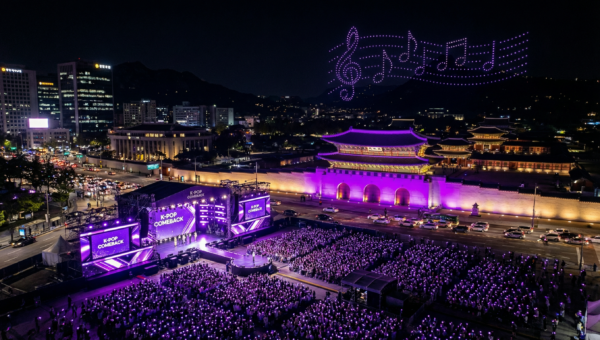
HYBE, SM Entertainment, JYP Entertainment, and YG Entertainment are pushing K-pop toward one of its boldest collective bets in years. The four companies are working on a joint venture tied to a large-scale festival project tentatively called Fanomenon, with South Korea targeted for a 2027 debut and additional global stops under discussion for 2028. If the plan moves ahead, the story will not just be about one lineup or one weekend. It will mark a rare moment when K-pop’s fiercest corporate rivals decide that scale matters more than separation.
That is why this news matters now. K-pop has already proven that it can dominate charts, touring markets, and fan communities across continents. What it has not fully built yet is a recurring flagship festival in its own image, one that gathers multiple powerhouse rosters under a single brand and turns Korean pop into the center of a destination event. The proposed Fanomenon model points in exactly that direction. It also arrives at a moment when festival culture, fan travel, and the global market for live music are all moving in K-pop’s favor.
What the Fanomenon project actually is
Recent reporting from Asian and Korean media shows a consistent outline. HYBE, SM Entertainment, JYP Entertainment, and YG Entertainment have been linked to a joint venture filing connected to concert planning and large-scale festival production. Coverage also says the companies are working through Fair Trade Commission procedures, which means the idea has moved beyond rumor while still remaining subject to approval and internal coordination. In other words, the project is real enough to be planned and reviewed, but not final enough to be treated as a locked business launch.
The proposed event name, Fanomenon, combines the words ‘fan’ and ‘phenomenon.’ That branding choice says a lot about how the agencies want this story to land. They are not pitching the festival as a normal concert series. They are pitching a fan-driven cultural event big enough to gather multiple artist ecosystems, convert fandom power into destination travel, and expand the global image of K-pop as an industry rather than a loose collection of hit acts.
Seoul Economic Daily reported that the four companies described the initiative this way: “This joint venture initiative is being discussed as a collaborative model to explore the expansion potential of K-culture, including K-pop, in the global market.” That line matters because it frames Fanomenon as more than a ticketing play. The companies are treating it as a platform for export growth, cultural branding, and long-term event infrastructure.
Why HYBE, SM, JYP, and YG would join forces now
On paper, this alliance looks unusual. These agencies compete for talent, chart attention, advertising budgets, touring routes, and investor confidence. They do not usually share the same stage unless an award show or public event makes it unavoidable. Yet the live-music business has become large enough to reward cooperation when the goal is global scale. A major festival can create value that no single label can fully unlock alone, especially if the objective is to build a recurring brand that fans around the world begin to treat as a must-attend annual stop.
There is also a timing advantage. K-pop has spent the past few years increasing its visibility at Western festival sites, from headline appearances to high-profile crossover stages. That exposure proved that the demand exists. The next logical step is to stop borrowing prestige from legacy festivals and start building a signature destination of its own. If Coachella and Glastonbury represent global music ecosystems shaped by Western history, Fanomenon could become the event designed around K-pop’s own production culture, fandom habits, and performance logic.
Just as important, the four-agency structure solves one of K-pop’s oldest live-event limitations. A single-company festival can be strong, but it usually reflects one catalog and one fan base. A multi-label festival can deliver range. HYBE brings global superstars and newer crossover acts. SM brings legacy influence and polished performance traditions. JYP brings broad mainstream reach and a track record of turning groups into international touring names. YG brings style, attitude, and artists with proven pull across fashion, streaming, and live crowds. Put those catalogs together and the result starts to look less like a company showcase and more like a genuine industry event.
The J.Y. Park quote that explains the ambition
The clearest articulation of the project’s scale comes from J.Y. Park. According to Seoul Economic Daily, he introduced the idea at the Popular Culture Exchange Committee launch ceremony and said, “After two years of preparation, we will hold the Fanomenon festival every December in Korea starting in December 2027, and from May 2028, we will hold this festival in major cities around the world.” That is not the language of a trial balloon. It is the language of a long-range blueprint.
Park also made the competitive target impossible to miss. “Our goal is to create a new festival that surpasses Coachella, America’s largest music festival,” he said. Whether or not the final event reaches that benchmark, the statement tells fans and the industry exactly how the project wants to position itself. This is not supposed to be a regional side event. It is supposed to be a global reference point.
That quote also gives the story the artist-producer voice many corporate announcements lack. J.Y. Park is not merely an executive name attached to a filing. He is one of the defining creative figures behind modern K-pop’s expansion. When he talks about a festival bigger than Coachella, he is drawing from decades of experience in idol production, overseas growth, and the business of translating fan emotion into large public moments. Even for readers who remain skeptical, the ambition itself becomes part of the headline.
What a Korean Coachella would change for K-pop
If Fanomenon happens, the biggest shift may be symbolic before it becomes financial. K-pop has long been measured by how well it performs inside existing Western structures: Billboard rankings, U.S. arena tours, festival guest slots, and crossover collaborations. A large homegrown festival flips that equation. Instead of asking whether K-pop can fit into a preexisting global format, it asks whether the global format can be redesigned around K-pop.
The economic effect could be just as significant. Destination festivals create hotel demand, retail spending, restaurant traffic, flight bookings, local transport activity, and international media attention. Recent K-pop touring data has already shown that major acts can move fans across borders at remarkable speed. A festival that gathers artists from the biggest four agencies could scale that pattern into a yearly travel event. For South Korea, that would turn cultural influence into place-based spending. For the companies, it would diversify revenue beyond albums, streaming, brand deals, and regular arena routes.
There is also a curation question that makes the project more interesting than a simple super-show. A real festival needs more than top-billed stars. It needs stage identity, discovery value, visual storytelling, scheduling logic, and enough genre spread to keep a full weekend compelling. K-pop is well built for that challenge. The industry can move from polished boy-group sets to experimental girl-group performance, from band-based stages to DJ-oriented after-hours programming, and from rookie showcases to legacy reunion moments without losing cohesion. That gives Fanomenon a chance to feel like a world rather than a playlist.
The risks behind the headline
The biggest caution is simple: none of this is finished yet. The companies have said the project remains under review, and coverage says regulatory approval and governance details are still being discussed. Equal investment sounds neat in a headline, but running a cross-company festival is messy in practice. Questions around booking priorities, branding hierarchy, scheduling fairness, revenue allocation, sponsorship rights, and creative direction can become serious pressure points once the planning gets concrete.
Audience expectations will also be intense from day one. The minute the phrase ‘Korean Coachella’ enters circulation, fans start imagining dream lineups that may be impossible to deliver in a first edition. Military service schedules, comeback timing, world tours, solo promotions, and label politics can all affect who is available. Even if the event launches successfully, the public will judge it not only by attendance or sales but by whether the lineup feels historic enough to justify the ambition.
Still, those risks do not weaken the significance of the news. They define it. A serious K-pop mega-festival has always been a complicated idea. The fact that HYBE, SM Entertainment, JYP Entertainment, and YG Entertainment are willing to test that complexity together is the real development. Even before the first ticket goes on sale, the industry has already crossed an important line. Its most powerful companies are no longer thinking only in terms of group comebacks and company concerts. They are thinking in terms of shared infrastructure, global event ownership, and long-cycle cultural scale.
Why this could become one of K-pop’s defining live events
Fanomenon may still be a proposal, but it already captures a major truth about where K-pop is heading. The genre is no longer satisfied with proving that its artists can appear on the world’s biggest stages. It wants to build one of those stages on its own terms. That is why the story is bigger than one filing and bigger than one slogan about surpassing Coachella. It is a statement that K-pop’s next growth phase could be organized around event ownership, destination fandom, and a festival model built by the industry’s most influential players together.
If the project survives review and becomes real in 2027, the first edition of Fanomenon will be judged as a festival. Before that happens, it is already being judged as a signal. Right now, that signal is loud and clear: HYBE, SM Entertainment, JYP Entertainment, and YG Entertainment are trying to turn K-pop’s competitive power into a single global event. For fans, promoters, and rivals alike, that makes this one of the most important K-pop festival stories of the year.
Sources referenced for reporting context include recent coverage from Seoul Economic Daily and Malay Mail, with additional same-day confirmation from widely circulated international reports about the joint venture filing and the proposed Fanomenon timeline.