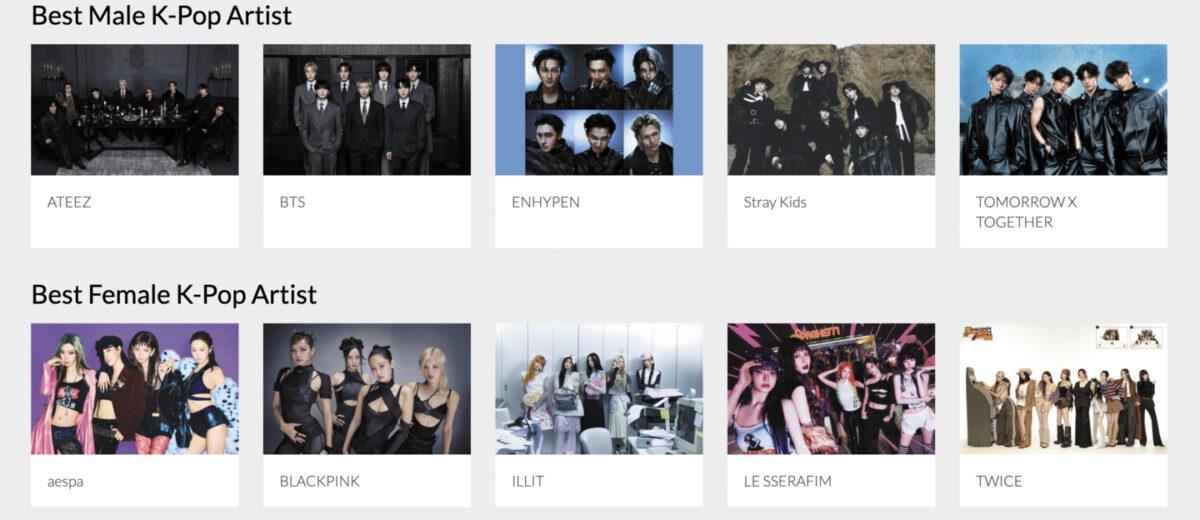
The 2026 American Music Awards nominations did more than give K-Pop fans a new voting season. They offered a clear snapshot of where Korean pop now stands inside the wider U.S. music conversation. This year’s nominee list turned one point into a headline immediately. BTS did not just appear in the genre field again. The group landed in Artist of the Year, the AMAs’ top race, while also picking up nods for Best Male K-Pop Artist and Song of the Summer for “SWIM.” At the same time, the K-Pop sections themselves remained crowded and competitive, with BLACKPINK, aespa, ILLIT, LE SSERAFIM, and TWICE filling the female category, and ATEEZ, ENHYPEN, Stray Kids, and TOMORROW X TOGETHER joining BTS on the male side.
That combination is what makes the 2026 American Music Awards K-Pop nominations one of the most important K-Pop news stories of the day. The story is not only about how many names appeared. It is about how the center of gravity shifted. BTS moved beyond the K-Pop lane into one of the ceremony’s biggest categories. BLACKPINK added another major U.S. nomination to a long-running global track record. Jennie’s Tame Impala remix of “Dracula” reached the Song of the Summer field. KATSEYE also collected three nominations, which shows how K-Pop-adjacent acts shaped by Korean pop systems now matter inside the same awards ecosystem. The result is a nomination slate that feels broader, more layered, and harder to dismiss as a niche add-on.
Why BTS’ Artist of the Year nomination changed the tone of the story
Soompi, Yonhap, and Korea Herald all treated BTS as the biggest K-Pop headline inside the 2026 AMA announcement, and the reason is easy to see. According to Soompi, BTS earned three nominations this year, including Artist of the Year, Song of the Summer for “SWIM,” and Best Male K-Pop Artist. Yonhap added that BTS previously made history in 2021 as the first Korean act to win the top honor, which gives this latest nomination a longer arc. This is not a novelty mention. It is a return to the room where the biggest global pop acts compete.
Korea Herald pushed the story further by linking the nomination to BTS’ current chart strength. The paper noted that “SWIM” remained inside the Billboard Hot 100 top five for a third straight week and that Arirang continued to dominate across the Billboard 200, Artist 100, album sales, and digital song sales charts. That context matters for SEO and for readers alike because it answers the obvious question behind every awards headline. Why now. The answer is that BTS entered the 2026 AMAs with chart numbers that made a top-field nomination look like the natural extension of a major comeback cycle rather than a symbolic gesture.
The nomination also sharpens the distinction between ‘K-Pop recognition’ and ‘main-field recognition.’ BTS still appears in the dedicated K-Pop category, but the bigger signal comes from the main Artist of the Year race. That is where the group stands next to global heavyweights rather than only genre peers. For the broader K-Pop industry, that kind of placement sets a benchmark. It suggests that U.S. award institutions are willing to frame a Korean act as a full-pop contender at the highest level when the data supports it.
The K-Pop categories stayed crowded, competitive, and strategically important
The official American Music Awards release confirmed the full K-Pop fields. In Best Male K-Pop Artist, the nominees are ATEEZ, BTS, ENHYPEN, Stray Kids, and TOMORROW X TOGETHER. In Best Female K-Pop Artist, the nominees are aespa, BLACKPINK, ILLIT, LE SSERAFIM, and TWICE. Those two lineups tell their own story. The AMAs are not treating K-Pop as a one-name category held together by a single superstar. They are presenting it as a competitive field with multiple active contenders, distinct fandoms, and real voting stakes.
The female category is especially notable because it brings together different generations and strategies at once. BLACKPINK represents long-proven global recognition. TWICE continues to hold major international visibility. aespa remains one of the strongest digital-era girl group brands. LE SSERAFIM and ILLIT reflect how newer HYBE-era acts have built fast overseas traction. Seen together, the list functions almost like a compressed map of the current girl-group landscape. No single company or sound dominates the picture completely.
The male field works the same way. BTS is the headline name because of the top-category breakthrough, but the category also keeps ATEEZ, ENHYPEN, Stray Kids, and TOMORROW X TOGETHER in direct comparison inside one mainstream U.S. awards structure. That matters because award-season visibility often shapes search traffic, casual-listener discovery, and fandom mobilization all at once. A nomination is not only a trophy opportunity. It is also a distribution event for attention.
BLACKPINK and Jennie showed how the female side of the nomination slate held its ground
If BTS gave the 2026 AMA K-Pop nominations their biggest crossover angle, BLACKPINK gave the story one of its clearest public reactions. On its official Facebook account, BLACKPINK wrote, “Honored to be nominated for the 2026 @AMAs,” then followed it with a direct message to fans, “BLINKS, YOU GUYS ARE THE BEST.” That line may look simple, but it gives the nomination cycle a useful artist-side frame. It turns the category mention into a live campaign moment and reminds readers that voting-based awards still depend on organized fan energy.
“Honored to be nominated for the 2026 @AMAs. BLINKS, YOU GUYS ARE THE BEST.”
BLACKPINK, via the group’s official Facebook post
BLACKPINK’s nomination in Best Female K-Pop Artist did not arrive alone. Soompi also noted that Jennie’s Tame Impala remix of “Dracula” earned a place in Song of the Summer. That detail strengthens the article’s wider point. The 2026 nomination slate did not split neatly between group recognition and solo recognition. Instead, it allowed both to coexist. BLACKPINK remained present as a group-level awards force, while Jennie’s individual release entered one of the more visible pop-facing categories on the board.
For readers following K-Pop chart news and awards strategy, this matters because it shows how female acts are sustaining visibility through multiple routes. Group identity still drives headline value, but solo moves can create a second path into the same media cycle. That is a useful reminder in a year when competition for attention is split across comeback campaigns, festival appearances, world tours, and soundtrack tie-ins.
KATSEYE and soundtrack nominations widened the conversation beyond the usual group list
Another reason this AMA nomination story feels bigger than a routine K-Pop category update is the presence of KATSEYE and KPop Demon Hunters. Soompi reported that KATSEYE secured three nominations, including New Artist of the Year, Best Music Video for “Gnarly,” and Breakthrough Pop Artist. Yonhap separately confirmed the same point and added that the KPop Demon Hunters soundtrack joined the ballot while “Golden,” performed by HUNTR/X vocalists EJAE, Audrey Nuna, and Rei Ami, collected multiple nods.
This part of the slate changes the shape of the article. If the piece focused only on BTS and BLACKPINK, it would read like another update on familiar top-tier names. KATSEYE and soundtrack-related nominations make the picture wider. They suggest that the K-Pop model now reaches U.S. award spaces through several channels at once: traditional idol groups, solo collaborations, globally built girl groups tied to Korean pop training systems, and media properties that package K-Pop aesthetics for a broader entertainment audience.
That does not mean every nominee belongs to the same industry lane. It means the AMAs are now handling K-Pop as part of a larger pop-network effect. Korean acts are still the center of the story, but adjacent acts and projects are entering the same awards grammar. That is a meaningful development because it shows how K-Pop’s influence is now measured not only by chart peaks, but also by how widely its formats and performance logic circulate.
What the 2026 AMA nominations say about K-Pop’s current U.S. position
The official AMA release states that nominees were selected through fan interactions including streaming, album and song sales, radio airplay, and tour grosses, with Billboard and Luminate tracking the data between March 21, 2025 and March 26, 2026. That matters because it roots the entire nomination slate in measurable performance rather than vague prestige. In other words, the K-Pop names on this list are there because they generated enough real activity to compete inside the same data system used for the rest of the show.
That is why the 2026 American Music Awards K-Pop nominations deserve more than a quick roundup. BTS in Artist of the Year signals that a Korean act can still break into the ceremony’s central field when the comeback is big enough. BLACKPINK and Jennie show that female-side relevance remains strong across both group and solo lines. The male and female K-Pop categories themselves remain deep with recognizable contenders. KATSEYE and KPop Demon Hunters reveal how far the K-Pop conversation now stretches beyond a fixed list of idol teams.
Voting for the 2026 AMAs is already open and closes on May 8, with the ceremony set for May 25 in Las Vegas. That means this nomination wave will not disappear after one news cycle. It will continue to drive fan campaigns, search spikes, and media follow-ups over the next several weeks. For now, the clearest takeaway is simple. The 2026 AMAs did not just acknowledge K-Pop again. They built one of the day’s strongest stories around how deeply K-Pop now sits inside the machinery of global pop recognition.