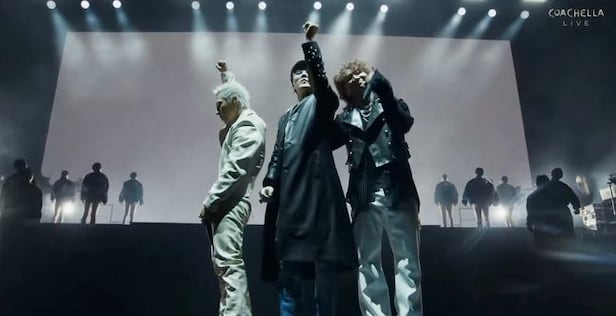
BIGBANG’s Coachella 2026 return felt bigger than a festival booking. It felt like a delayed promise finally being kept in public, on one of the most visible stages in global pop. On April 12 in Indio, California, G-Dragon, Taeyang, and Daesung walked onto the Outdoor Theatre stage and turned a long-awaited reunion into one of the most talked-about K-Pop moments of the past 24 hours. For a group that was originally set to appear at Coachella in 2020 before the pandemic erased the plan, this performance carried the weight of unfinished history, fan anticipation, and a new anniversary campaign all at once.
That is why BIGBANG Coachella 2026 quickly became a major search topic across K-Pop media. The trio did not simply show up for nostalgia. They arrived with a career-spanning set, solo turns that reminded the audience how distinct each member remains, and clear signals that their 20th anniversary will not pass quietly. In an era where comeback language can feel routine, BIGBANG’s return at Coachella landed as an event with genuine scale.
Why BIGBANG’s Coachella 2026 return mattered immediately
The biggest reason this moment mattered is simple. BIGBANG had been linked to Coachella before, but fans never got the performance they were promised. The group had been invited to the festival in 2020, yet the event was canceled during the Covid-19 period. That missed appearance stayed in the background of every discussion about the group’s global live legacy. Their 2026 performance finally closed that chapter and opened a new one.
Coverage from Korea JoongAng Daily framed the set as BIGBANG’s first activity under the group name since the release of Still Life in 2022, while Chosun English described the show as the opening act of the trio’s 20th-anniversary project. Those two points matter for anyone tracking the wider K-Pop industry. This was not a one-off surprise cameo. It was presented as the start of a broader cycle, with anniversary promotions and a new tour narrative already taking shape around it.
Billboard’s Coachella roundup also treated BIGBANG as a major festival moment, stressing that twenty years in the K-Pop business is a rare feat for any idol group and noting that the trio were one of only two K-Pop acts on this year’s lineup alongside Taemin. That framing tells you how the international press saw the performance. BIGBANG were not written about as a curiosity from an older generation. They were written about as senior stars whose return still carried headline value.
A setlist built to connect legacy, spectacle, and identity
Reports across multiple outlets agree on the core shape of the performance. BIGBANG opened with BANG BANG BANG, the kind of song that can jolt a crowd into instant recognition, then moved through signature titles that helped define different stages of their catalog. Chosun English listed Fantastic Baby, Loser, and Lies among the key songs in the set. Billboard’s extracted lines also pointed to a hit run that included Bang Bang Bang, Fantastic Baby, Haru Haru, Lies, and Still Life. ABS-CBN added Sober and A Fool of Tears to the picture, showing that the performance moved across both explosive festival tracks and emotionally loaded fan favorites.
That balance was crucial. A Coachella audience includes dedicated fans, casual listeners, industry watchers, and people who only know a few songs. BIGBANG’s answer was to build a set that worked on all of those levels. The louder tracks proved that the group can still command a desert festival crowd with sheer force. The older songs widened the emotional frame and reminded viewers how much of modern K-Pop performance language runs through BIGBANG’s catalog.
The solo stages also mattered. According to Chosun English and ABS-CBN, Taeyang performed Ringa Linga, G-Dragon performed Power, and Daesung brought a strikingly individual touch with trot-inflected selections including Look at Me, Gwisun. Chosun’s report noted that Daesung’s choice showed the diverse charm of Korean music on a global festival stage. In practical terms, those solo moments did two jobs at once. They gave the set pacing and contrast, and they reminded the crowd that BIGBANG’s identity has always depended on strong individual color rather than uniform presentation.
“It’s so nice to finally meet you in person. I’ve been waiting for this moment for so long.”
Daesung at Coachella 2026, as reported by ABS-CBN
That line helps explain why the set resonated so quickly. The performance was not sold as a cold victory lap. It was framed as a meeting that had taken too long to happen. For fans who had followed the canceled 2020 booking and the group’s years of fragmented activity, the emotional release became part of the news value.
How the 20th anniversary transformed a festival slot into comeback strategy
BIGBANG’s Coachella appearance would already have been significant as a reunion performance. What made it more powerful was the way the group and its media coverage tied the show directly to a larger anniversary campaign. Chosun English reported that the members said, “This year marks our 20th anniversary. This Coachella stage holds great significance for us. Please look forward to everything we will present as BIGBANG.” The same report added their teaser line, “Something big is coming soon.”
ABS-CBN carried a similar message from the stage. Taeyang reportedly told the audience that the performance “means a lot to us,” while G-Dragon said, “This year is BIGBANG’s 20th anniversary and it just started. We’ve got some big things coming soon.” That kind of language does more than excite a crowd in the moment. It gives media outlets and search traffic a clear next-step story. Suddenly the Coachella set is not the entire headline. It becomes the first headline in a chain that may include a tour, new music, anniversary content, or all three.
Korea JoongAng Daily reinforced that reading by reporting that BIGBANG will continue their 20th-anniversary comeback activities this year and return for the festival’s second weekend. Chosun English went further by saying the group planned to announce a new global tour as part of the anniversary push. For a blog focused on K-Pop comeback news and major event analysis, that makes BIGBANG Coachella 2026 more than a live review topic. It becomes the starting gun for one of the biggest legacy-group storylines of the year.
There is also a broader industry angle here. Anniversary campaigns can easily lean on memory alone, especially for veteran acts whose influence is already secure. BIGBANG chose a different path. They used Coachella, a festival associated with current relevance and international visibility, to announce that their history still belongs in the present tense. That was a sharp strategic move. It linked a twenty-year legacy to a venue where global conversation moves fast and where each standout set can reset public attention overnight.
What the global reaction says about BIGBANG’s place in K-Pop now
One of the strongest signs of the performance’s impact came from how reporters described the crowd. Korea JoongAng Daily wrote that BIGBANG drew a roaring audience and quoted the Los Angeles Times line that the group “drew a huge crowd with a set long on sexed-up party jams and exposed abdominal muscles.” Chosun English also emphasized the explosive cheers that greeted the trio and the sense that their collective presence still hits differently when all three members share a stage.
That reaction matters because BIGBANG’s position inside K-Pop is unusual. They are not only a famous group with old hits. They are one of the acts most often cited when people talk about idols as artists, self-styled performers, and culture-shaping figures rather than only product-driven stars. Korea JoongAng Daily pointed to their influence on the idea of the “artist idol,” with members participating in music-making and image-building in a way that helped expand expectations for male idol groups.
At the same time, this Coachella return worked because it was concrete. It was not just a discussion about legacy, impact, or memory. It was a real set, in front of a real crowd, built around songs that still travel. When Billboard highlights BIGBANG as a notable Coachella moment and when regional and Korean outlets alike describe the reunion as one of the festival’s major talking points, that suggests the group’s value is still active in the market. Their influence is historical, but their drawing power remains current.
What comes next after BIGBANG’s Coachella comeback
The most immediate next step is clear. BIGBANG are set to perform again during Coachella weekend two, which means the conversation around the trio will continue for at least another cycle of festival coverage and fan reaction. Beyond that, the stronger story is the 20th anniversary roadmap now taking shape in public. The quotes from the stage, the reporting about upcoming activities, and the way multiple outlets tied the performance to a larger comeback strategy all point in the same direction.
For K-Pop fans, the question is no longer whether BIGBANG can still create an event. Coachella answered that. The real question is how far the group will take this momentum. If a global tour follows, the festival set will be remembered as the moment the anniversary era truly began. If new music appears, Coachella will read as the carefully chosen launch point that turned anticipation into movement.
For the wider K-Pop industry, BIGBANG Coachella 2026 is already a useful case study. It shows how a veteran act can return without shrinking itself into a heritage act. It shows how a global festival can serve both nostalgia and forward strategy. Most of all, it shows that when the material, the timing, and the symbolism align, a comeback does not need to feel recycled. It can feel newly urgent.
That is why this performance stands out from the rush of daily K-Pop headlines. BIGBANG did not just revisit the stage they once missed. They turned that delay into narrative power, wrapped it inside a twenty-year milestone, and gave the market a new reason to watch what comes next. In the crowded field of K-Pop news today, that makes their Coachella return more than a reunion story. It makes it one of the clearest comeback statements of 2026 so far.