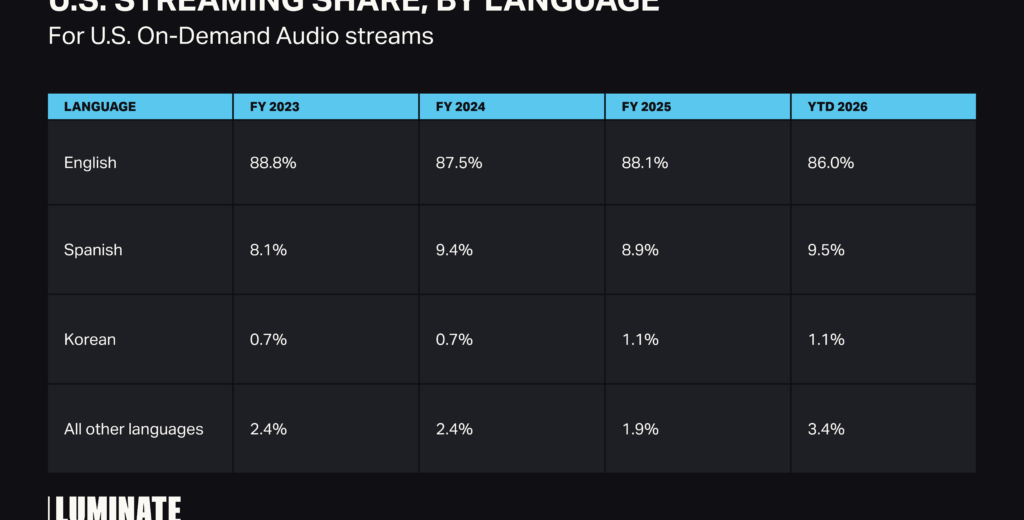

The global music landscape is experiencing a profound transformation, and the numbers are finally catching up to what fans have known for years. According to a comprehensive Q1 2026 report released by Luminate, a leading U.S.-based music and entertainment data research firm, Korean-language music has officially cemented its position as the third most-streamed language in the United States. This milestone represents not just a fleeting trend, but a fundamental shift in how American audiences consume audio content, breaking down historical barriers that once confined international artists to niche markets.
The Luminate data reveals that Korean songs accounted for a solid 1.1 percent of the U.S. on-demand audio streaming market during the first quarter of this year. While this percentage might seem modest at first glance, it is a significant achievement in a highly competitive market traditionally dominated by domestic acts. Korean now trails only behind English, which commands 86 percent of the market, and Spanish, which hit an all-time high of 9.5 percent. This steady growth from 0.7 percent in 2023 and 2024 demonstrates that K-pop’s influence is sustainable and expanding beyond its dedicated core fandom.
The Numbers Behind the Cultural Shift
Diving deeper into the statistics, the diversification of America’s streaming habits becomes even more apparent. English-language music consumption in the U.S. dropped by 2.1 share points year-over-year, falling from 88.1 percent in Q1 2025 to 86 percent in 2026. This decline highlights a growing appetite for international sounds. Meanwhile, music in languages other than English, Spanish, and Korean has also seen a remarkable increase, accounting for 3.4 percent of total streams, up from 1.9 percent just a year ago.
Furthermore, South Korea has proven its immense cultural export power by ranking fifth among all foreign countries with a 1.8 percent overall share in the American music streaming market, successfully surpassing Australia. The United Kingdom remains in the top spot with a 7.8 percent share. The fact that a non-English speaking country is competing so fiercely on the U.S. charts is a testament to the high-quality production, innovative marketing, and unparalleled artist-fan connection that defines the K-pop industry.
“The industry is more global than ever, which has allowed international artists to reach a level of global recognition historically reserved for English-speaking acts.”
Luminate Q1 2026 Report
BTS, Stray Kids, and the Power of Organic Discovery
The sustained 1.1 percent market share for Korean music is heavily driven by the massive impact of top-tier K-pop groups. Luminate specifically highlighted the power of K-pop sensations like BTS, whose recent return to the world stage has reinvigorated the market. The group’s latest single, “Come Over,” a highly anticipated track released for the 2026 FESTA celebration, immediately soared to number one on iTunes in 79 countries. This organic push by fans proves that the demand for authentic, Korean-language music remains stronger than ever.
Other major players are also contributing significantly to this milestone. Stray Kids recently reached a new peak with their pre-release single “RUN IT,” which hit number two on the U.S. iTunes All-Genre Chart—their highest charting song in the U.S. to date. Additionally, cross-border collaborations are proving to be highly effective. For instance, BLACKPINK’s Jennie featured on Tame Impala’s “Dracula,” a track that spent four weeks in the Billboard Hot 100 Top 10 and dominated the Contemporary Hit Radio (CHR) format.
“Today’s streaming infrastructure allows fans to discover music organically, with language not a barrier to entry but rather a point of connection.”
Luminate Data Analysis
Redefining the U.S. Music Industry’s Future
The implications of this fragmentation in the U.S. streaming market extend far beyond the charts; they are reshaping the entire music ecosystem. Historically, the United States acted as a strict gatekeeper. International artists were often pressured to adapt to Western musical styles or record entire albums in English to achieve commercial success. The current landscape, however, tells a different story. Listeners are actively seeking out diverse sounds and are perfectly comfortable enjoying music in languages they may not speak.
This cultural shift is forcing major record labels to rethink their strategies. As Luminate’s report advises, Artists and Repertoire (A&R) teams can no longer rely purely on localized talent pools. To remain competitive in this evolving market, labels must invest heavily in international scouting, foster cross-border collaborations, and develop multilingual marketing strategies that mirror these changing consumer habits. The success of K-pop serves as the ultimate blueprint for this new global approach.
Corporate advertisers and brands are also taking note. Marketing campaigns, music festival lineups, and brand partnerships are increasingly required to reflect a multicultural, polyglot demographic. The days of a monolithic, English-only pop culture are fading, replaced by a vibrant international crossroads where K-pop sits comfortably at the forefront.
What This Means for the Next Generation of K-Pop
As we look toward the second half of 2026 and beyond, the foundation laid by established groups provides an incredible launchpad for the next generation of K-pop artists. With Korean firmly established as the third most popular language in U.S. streaming, rookie groups debuting today enter a market that is already primed and receptive to their sound. They no longer have to fight to legitimize their genre; instead, they can focus on pushing creative boundaries and connecting with a global audience.
The continuous rise of groups like RIIZE and BOYNEXTDOOR, who recently claimed top spots on global charts following their latest comebacks, indicates that the pipeline of talent is robust. As long as the industry continues to deliver high-quality music, captivating performances, and meaningful fan engagement, the 1.1 percent market share is likely just the beginning. The global music industry is listening, and K-pop is speaking louder than ever.